
I used the GetResponse free account which gave me 30-day free access to the premium features of GetResponse, one of the best email marketing software to see what it got to offer.
I know you want to start your email marketing campaign with GetResponse but first want to read a GetResponse review to be sure it’s worth it.
I will share my experience with you based on key features GetResponse offers and how they help to achieve your marketing goals.
You will learn about the pricing plans, pros and cons, and other important things that will help you decide if GetResponse suits your needs.

My Verdict On GetResponse
After using the 30-day free trial, I see GetResponse as an email marketing tool that’s worth it. Beyond email marketing, it offers easy-to-use advanced marketing features like webinars, conversion funnel, sales funnel, landing pages, website builders, email automation, autoresponder, etc. Ecommerce merchants can leverage GetResponse’s ecommerce features to recover abandoned carts, promote the latest products and use AI to recommend products that their audience will like.
Large enterprises and agencies aren’t left out as the GetResponse Max allows you to have customized features tailored to your operations. The only downside of it is that it doesn’t have a refund policy. But that shouldn’t be an issue because the 30-day free trial is enough for you to have a first-hand experience and decide if you want to be a paying customer.
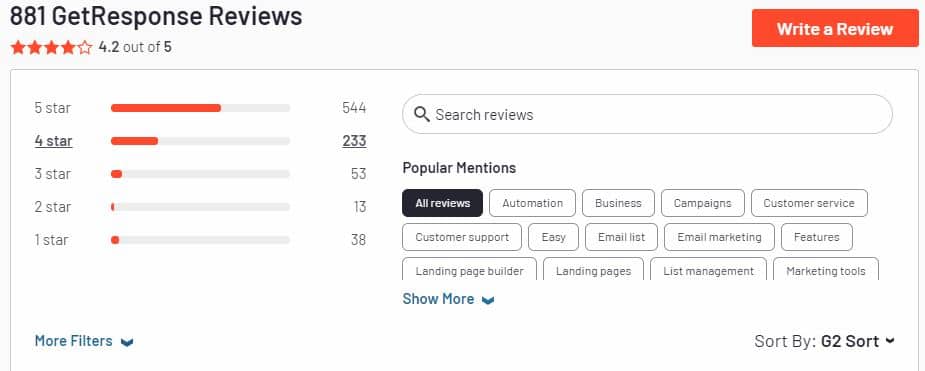
I even went further to research it on top-rated review sites and below is a chart of reviews verified customers gave about GetResponse on G2.com
Pros & Cons Of GetResponse
Pros: What I Like About GetResponse
- Supports 15+ languages
- It has a clean and easy user interface
- Integration with other marketing tools is easy you won’t experience technical hitches
- Dashboard and widgets are customizable so you can decide which tool or function comes in handy
- You can create, use, save, and re-use your own templates for different purposes
- Offers webinar hosting and a website builder to complement your email marketing campaign
- Tools and features are advanced and in line with the latest developments in email marketing such as the use of AI – it has already introduced the use of AI to generate subject lines that can boost your open rate
- The user interface is beginner-friendly and almost all the features are easy to use
Cons: What I Don’t Like About GetResponse
- It supports a few email marketing software when it comes to the automatic migration of contact lists. This means that if your previous email marketing software isn’t ActiveCampaign, Mailchimp, Aweber, or Constant Contact, you may have to use a connection service, manual method, or upload of a list.
- It can take a longer time when updating the landing page for mobile devices
- Pricing plans can be expensive
- Has no refund policy
GetResponse Pricing
GetResponse has 4 pricing plans:
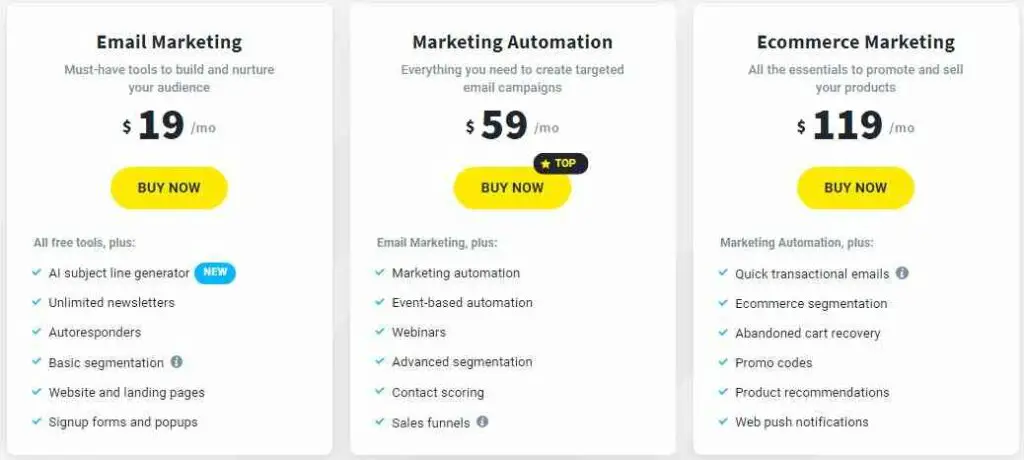
Email marketing plan: Starts at $19/month ( Up to 1000 contact lists)
Marketing automation plan: Starts at $59/month ( Up to 1000 contact lists)
Ecommerce marketing plan: Starts at $119/month ( Up to 1000 contact lists)
GetResponse Max: Custom pricing
GetResponse Max Plus: Custom pricing
The more you add subscribers to your list, the higher you pay on GetResponse.
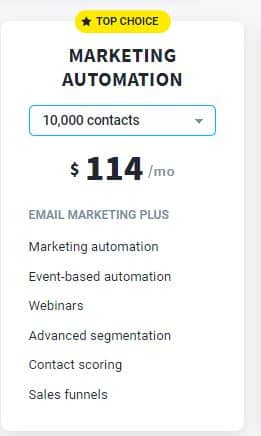
Let’s say I subscribed to the Marketing automation plan which is the most popular and my list grew from 1000 to 10000. To efficiently reach all my 10k subscribers, I have to upgrade your list. And that will see me pay $114/month.
Like this:
To have you committed to its services, GetResponse offers discounts which are as follows:
- 12-month plan – 18% discount
- 24-month plan – 30% discount
In addition to this, I discovered that GetResponse offers discounts to charities and non-governmental agencies (NGOs). This is its own way of giving back to society.
So, if you run an NGO or charity organization, GetResponse offers you a 50% discount monthly, but you must first reach out to them and provide proof you are one.
All the GetResponse pricing plans mentioned here aren’t equal. Their features differ and I will walk you through each of them as we progress in this GetResponse review.
You can also read this article where I reviewed GetResponse pricing.
A Quick Tour Of GetResponse Dashboard
After signing up for the free account, I quickly toured the dashboard since that’s where I can carry out every task.
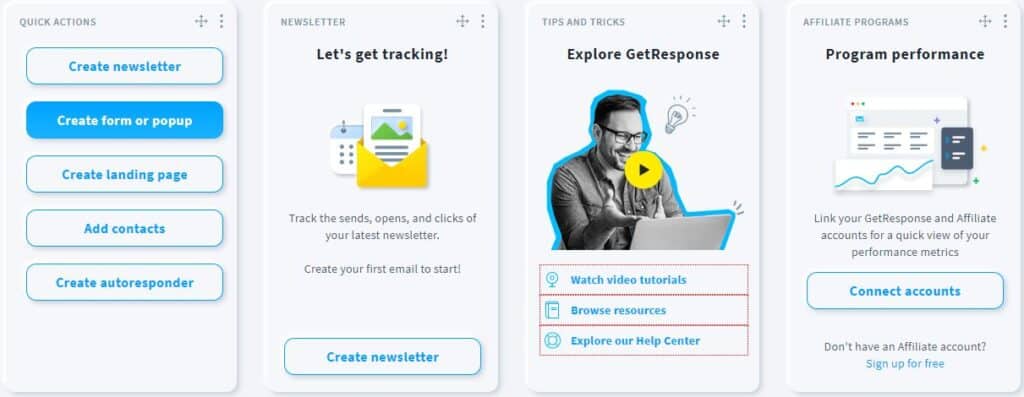
There are quick actions you can take, one of which is to create a newsletter and send it to your subscribers.
Creating a newsletter – This is the same as sending emails to your subscribers.
The process is simple:
- Enter sender and reply email addresses
- Write your subject line
- Add recipients
- Design your email content
- Schedule or send it immediately
- Then track clicks
I noticed a downside here which is you can’t do ecommerce tracking or track click with Google Analytics unless you upgrade to a higher plan.
Also, GetResponse launched a new feature – AI Subject Line Generator which you can use to generate catchy email subject lines that will increase your open rate. I will explore it more when we look at the core features of GetResponse.
Create form or popup – You can quickly create a pop-up and have it triggered for your target audience to take action like signing up or downloading your special offer. You can also embed your form anywhere on your page.
Create a landing page – Create a landing page for sign-ups and registration, promotion, digital downloads, sales, webinars, etc.
Add Contact – Add email addresses you have to your contact, so you can email them. You either add them one by one manually or upload a file, using an external service.
Create autoresponder – Reach your subscribers fast with automatically triggered emails at a particular time.
Now when you click on the Tools, you see all the tools GetResponse offers, starting from Contact to Web Connect.
Click on each of them to see how you can use them for your email marketing campaign.
Click on Contacts to see the email list you created, search option, segments, reports, list hygiene, suppression lists, custom fields, import statistics, and tags. The summary of the features of the Contact Tool is that you have all you need to manage your Contacts. If you are starting with a free account, you have a limit of 500 contacts.
The next tab is Email marketing!
Here you have tools to create a newsletter ( email), Draft where you save created emails that you aren’t ready to send, and do A/B test where you test two different emails with certain parameters to know which generates better results.
If you have created templates, saved and used them for email marketing, you will see them in My Templates – it’s like a folder.
There is also an option to send RSS emails to get your subscribers to know about your latest blog post immediately after you hit the publish button.
And finally is the Report tab.
Here you get the reports of your email marketing. Whether it’s autoresponder, email campaigns, automation messages, contacts, RSS emails, and email clients.
GetResponse even launched new features for the report tab – Ecommerce and product recommendation. This is for ecommerce merchants to get reports on email campaigns aimed at generating sales.
Watch this video below where I walked you through on GetResponse dashboard. It’s an overview of all I showed you above and will help you understand better.
Core Features Of GetResponse
Email Creator
GetResponse makes it easy to create emails with its drag-and-drop email creator. There are layouts and sections which you can use to design your email. You can schedule your emails, and preview your designs on your mobile and desktop versions before hitting the send button.
Email Templates
You have access to a library of over 120 pre-build email templates with professional designs that suit your email marketing campaign. And they are categorized, so you can easily find what you are looking for.
For example, there are templates for new product launches, holiday promotions, webinar invitations, etc.
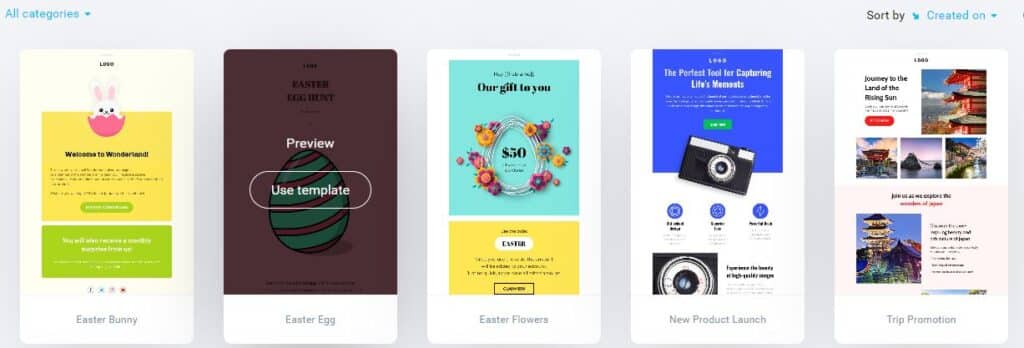
You can preview, edit and customize any pre-made template you choose to suit your needs.
If you are a guru in design, and you feel the pre-designed templates aren’t good for you, no worries because you can use the blank templates to create your own and even save it in My Templates, so you can use them for subsequent campaigns.
If you have templates that are in HTML, GetResponse has the HTML editor where you can paste them or even upload them from a ZIP.
AI Subject Line Generator
GetResponse recently launched this feature to help you generate powerful email subject lines. I think this is a huge improvement considering that a low open rate is one of the challenges email marketers face. Also, with the rate AI copywriting tools are spreading, marketing automation tools like GetResponse will be missing out if they don’t incorporate it into their system.
I think GetResponse was able to get this AI email subject line running via Open AI API, the creators of ChatGPT.